R&D: Audience Responsive Light and Material Systems
This page presents early exploratory research developed during a residency at Pervasive Media Studio.
This initial phase tested ideas around responsive light and sensing systems, and forms the foundation for a proposed research and development project focused on immersive, audience-responsive environments.
My R&D project will build on this early work through further material investigation, prototyping and the integration of glass, light and digital systems.
Project Overview
The research explores how immersive environments can emerge through the interaction of material, light and responsive technologies. It investigates how human presence, through movement, proximity and biometric signals, can be translated into shared spatial experience.
Rather than producing fixed outcomes, the work focuses on systems that evolve through participation, where individual and collective behaviour shape the environment in real time.
The Vision…
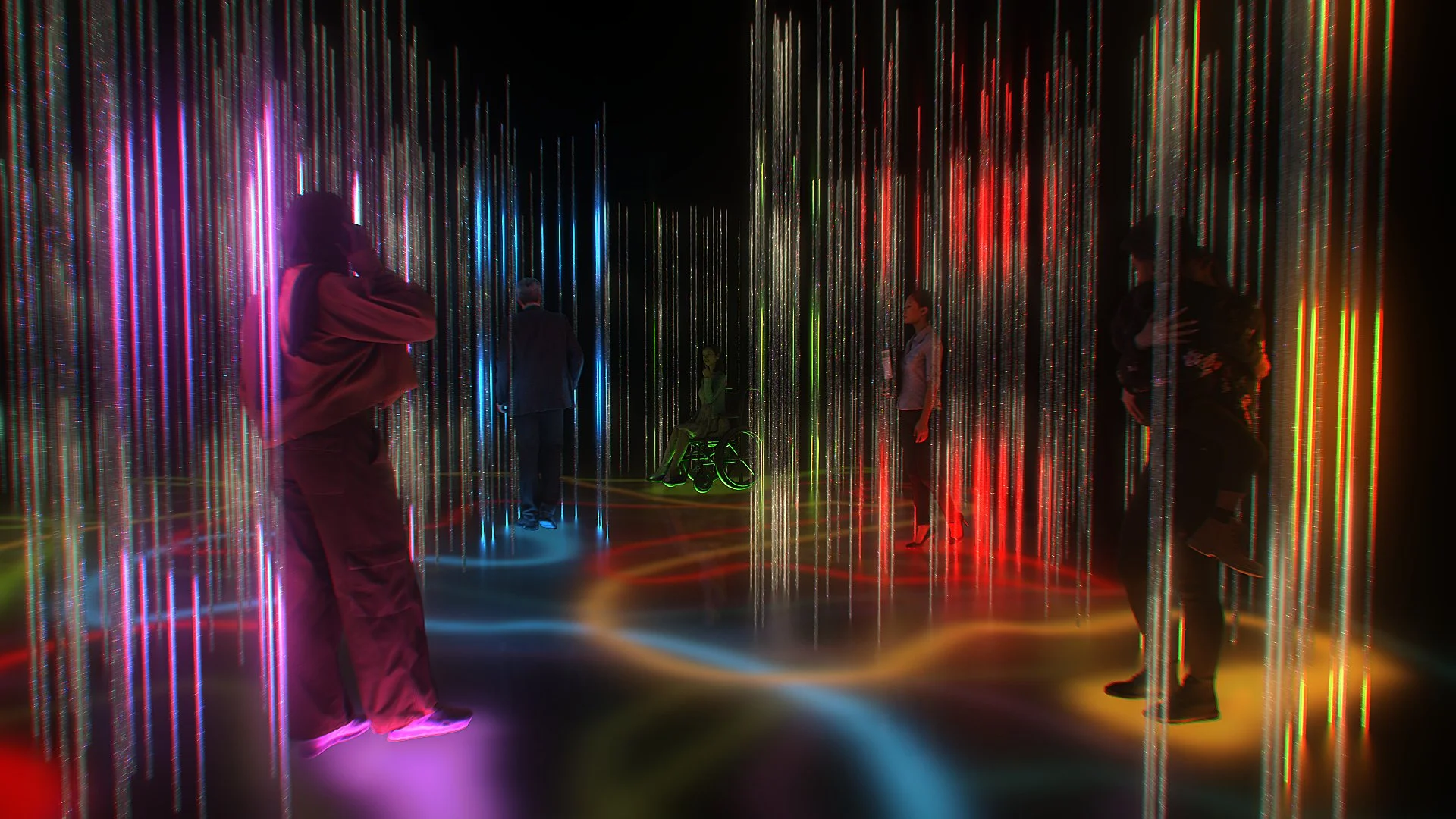
Computer rendering by the artist
‘Home is Where the Heart Beats’ (working title) is an immersive light and sound installation that listens to a space and reveals its living rhythm - a heartbeat that emerges through shared presence and resonance.
The work explores how individual signals can merge into a collective system, where rhythms synchronise, diverge and reform over time.
KEYWORDS:
Immersive Experience; Playful Co-creation; Interactive Installation; Creative technology; Materiality: Embodiment; Shared Presence
What?
Explores how people and environments influence one another over time
Draws on principles of synchronisation and shared rhythm
Considers “home” as something formed through relationships rather than fixed place
Home is where the heart is
How?
Sensors translate presence (movement, proximity, biometrics) into light and sound
A field of light responds in real time to participants
Individual rhythms merge into a shared, evolving system
Why?
Reveals the unseen connections through which people, spaces, and technologies continuously shape one another.
Suggests that identity and environment emerge through relationship rather than existing independently
Centres immediate, embodied experience as a counterpoint to increasingly disembodied digital interaction
Reframes technology as a gentle listener that amplifies connection rather than surveillance
Uses technology not to simulate reality, but to deepen sensitivity to the real, inviting visitors to feel themselves as part of a shared, evolving ecology
Draws on a practice journey from VFX to glassmaking, bringing digital responsiveness into dialogue with material and physical experience
The Story So Far….
Starting from scratch: Learning to control LEDs by coding an Arduino
Early Arduino and NeoPixel LED investigations. Got Arduino controlling LEDs, programmed in a ‘pulseWave’, tried triggering via motion sensor, but there’s too much delay. It’s not the right tool for the job I want it to do. An Ultrasound Proximity sensor is far more responsive and closer to what I want to happen!
Setting the timing of the ‘wavePulse’ was tricky - included smoothing readings, setting conditional boundaries and ‘locking in’ pulse rate. Next stage was getting 2 sensors working at the same time, to trigger different LEDs in different colours, including the pulse wave then mixing the colours at the meeting point. The last video brings us onto my first material investigations…
Material Research: Light and Glass
Alongside digital prototyping, the project explores how materials shape light within space. Glass is central to this investigation, due to its ability to refract, reflect and transmit light, producing dynamic optical effects such as caustics.
Early tests explore how diffused light, translucency and surface interaction influence perception, forming the basis for future work with blown and cast glass elements.
First Material Investigations - looking at the lights through different materials, using what is to hand. At this point I prefer the opaque white perspex with the lights set back so it becomes a moving glow rather than individual LEDs
I prefer the more opaque things so far - liking the 3 perspex sheets
Not sure these diffuse the individual lights enough as they are so close - even with 3 layers
Bubble wrap works really well to diffuse the light, making it a pulsing glow.
But… it looks like bubble wrap…
I really like the sculptural feel of the white fabric here
Tried out a couple of combinations, but don’t think i have the right one yet. I want to try the fabric behind the white opaque plastic and the bubblewrap behind the white plastic.
I absolutely love the way the lights look behind my caustic lens - I actually have quite a few of these, maybe I could use a few joined together? It would take a lot of cold working though, and I’d need a strong frame for them. I love that the caustic patterns are metaphors for the connections and interactions though…
keep coming back to the paraphrased Georges Braque quote…
THINK NOT OF THINGS BUT THE RELATIONSHIPS BETWEEN THEM
To be continued….. keep checking in!